
Till Jasmine EPOS
Does EPOS cost price include VAT?
Last updated 7 September 2026. How VAT and gross profit really work on Till Jasmine.
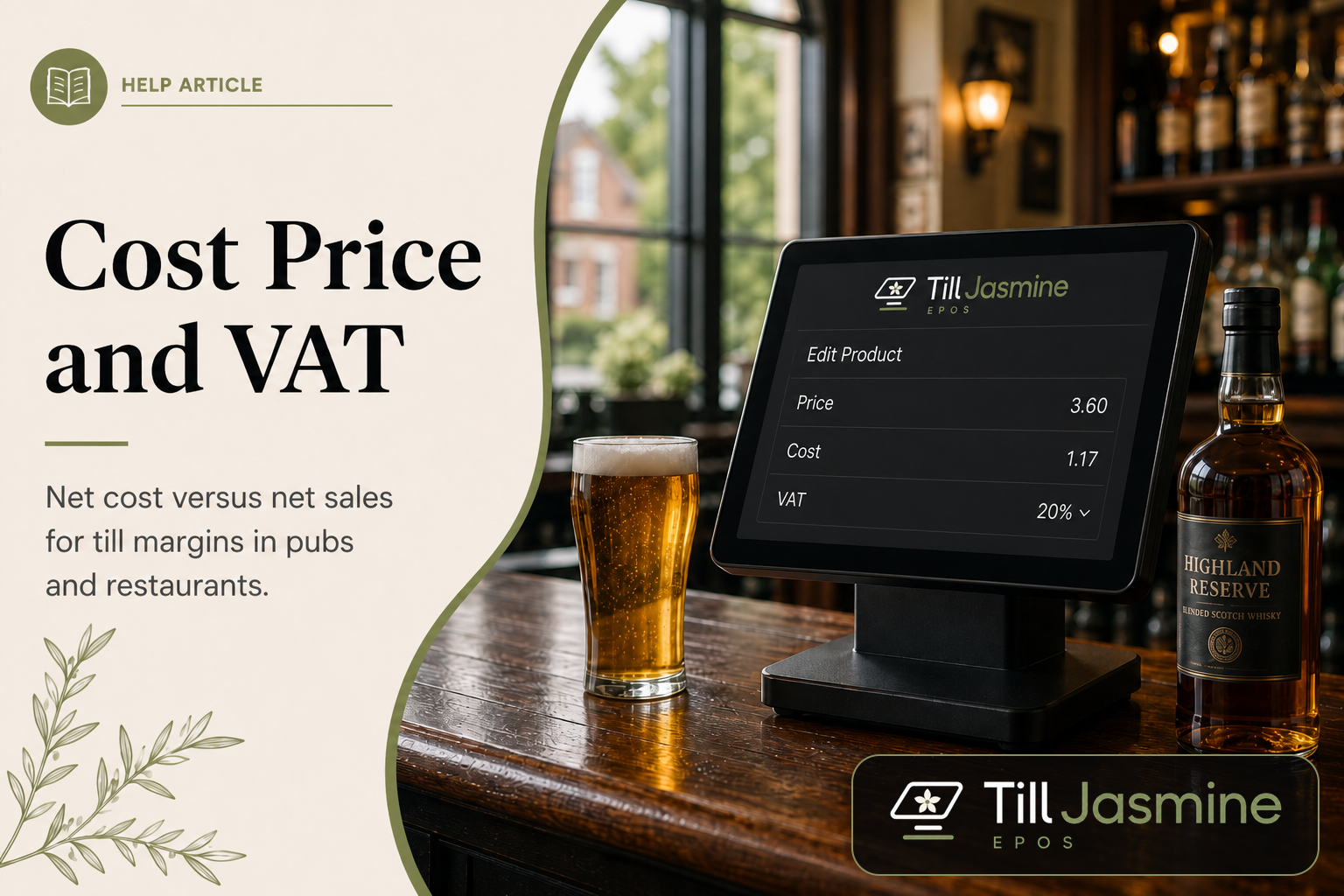
One of the most confusing parts of setting up products in an EPOS system is understanding what should go into the Cost price field.
Should you enter what you physically paid the supplier?
Should you enter the supplier's price before VAT?
If alcohol has 20% VAT, should you add another 20% to its cost price?
And what about food? Many UK venues buy food with little or no VAT, then charge 20% when it is eaten in. The purchase and the sale do not use the same rate, so the numbers can look like they do not add up.
And why do many EPOS systems let you choose a VAT rate for the selling price but do not give you an obvious "cost includes VAT" or "cost excludes VAT" option?
The answer becomes much easier once you understand that an EPOS system normally calculates gross profit by comparing net sales revenue with net product cost. Purchase VAT and sale VAT are two different things. They do not have to match.
In other words, for a VAT-registered business that can recover its input VAT, recoverable VAT is normally not treated as either revenue or a product cost when calculating gross profit. VAT that was never charged on the purchase is not invented and then stripped out either.
This sits alongside UK VAT on till products, which covers 20%, 5%, and 0% on the selling price.
The short answer: enter the cost after recoverable VAT — only if VAT was actually charged
For a VAT-registered business, the cost price entered into an EPOS system will normally be the net cost excluding any VAT that the business can reclaim.
If the supplier did not charge VAT — common on zero-rated food — there is nothing to reclaim. The amount you paid is the cost.
For example, imagine a bottle of alcohol costs £1.17 + VAT. At 20% VAT:
- £1.17 × 20% = £0.234 VAT
- Total invoice amount: £1.404
Your business may physically pay £1.404 to the supplier. Assuming the £0.234 is recoverable input VAT, your underlying product cost for gross-profit purposes remains £1.17.
That is why Till Jasmine expects you to enter £1.17, rather than £1.404. The VAT is dealt with separately through the VAT accounting process.
HMRC states that a VAT-registered business can deduct qualifying VAT incurred on goods or services used as a cost component of its taxable supplies, subject to the relevant conditions and evidence requirements.
Food and drink do not use the same VAT on the way in and the way out
This is the point that makes a single alcohol example look incomplete. In a UK pub, restaurant, or hotel, what you paid the supplier and what you charge the customer are not the same VAT question.
You often pay VAT on some stock and not on other stock. You then set a till VAT rate for how each item is sold — 20%, 5%, or 0%. Those two rates do not have to match, and the cost field does not try to force them to.
| Typical item | Bought from the supplier | Sold on the till | What goes in Cost price |
|---|---|---|---|
| Draught beer, wine, spirits | Usually 20% VAT on the invoice | Usually 20% on the sale | Net goods, after reclaimable VAT |
| Eat-in meal or sandwich | Many food ingredients are zero-rated — no VAT on the purchase | Usually 20% catering | What you paid. Do not invent 20% to strip off |
| Cold takeaway food | Often no VAT on the purchase | Often 0% | What you paid |
| Crisps, sweets, most soft drinks | Usually 20% on the invoice | Usually 20% on the sale | Net goods, after reclaimable VAT |
So the cost does add up — once you stop expecting purchase VAT and sale VAT to be the same number. Till Jasmine compares:
- Net cost — the stock cost after any VAT you can actually reclaim on that purchase
- Net sale — the selling price after the VAT rate set on that till product
Example: food bought without VAT, sold eat-in with VAT
Suppose a sandwich costs £1.20 from a wholesaler and the invoice shows no VAT — the food is zero-rated. You enter Cost price £1.20.
You sell it eaten in for £4.80 including 20% VAT. Net sale is £4.80 ÷ 1.20 = £4.00. Gross profit is £4.00 − £1.20 = £2.80, a 70% margin.
You still account for £0.80 output VAT on the sale. There was no input VAT on the purchase to reclaim. That is normal, not a broken cost.
If you wrongly divided the £1.20 food cost by 1.20 because "we charge VAT", the till would show a cost of £1.00 and an inflated margin. The business did not get that 20% back from HMRC — it was never charged.
VAT on the selling price is different from VAT on the cost
When you buy stock, any qualifying VAT charged by your supplier is generally called input VAT. When you sell products to your customers, the VAT you account for is generally called output VAT. These should not normally be mixed together when calculating gross profit.
Consider an alcohol product sold through an EPOS for £3.60 including 20% VAT.
You cannot simply take 20% of £3.60 to find the VAT, because the £3.60 already includes the VAT. Instead, remove it:
- £3.60 ÷ 1.20 = £3.00
- Net sale = £3.00
- VAT = £0.60
- Gross customer price = £3.60
HMRC gives the same underlying principle: when a cash price includes 20% VAT, the value before VAT is the amount which, after adding 20%, produces the total consideration.
Another useful shortcut is: VAT contained in a 20% VAT-inclusive price = Gross Price × 20/120. So £3.60 × 20/120 = £0.60 VAT.
VAT is not 20% of the VAT-inclusive selling price
This is a very common mistake. If a product is sold for £3.60 including VAT, the VAT is not:
£3.60 × 20% = £0.72
That would only be correct if £3.60 were the net price before VAT. If £3.60 is already VAT-inclusive, then net price is £3.00, VAT is £0.60, and the VAT portion is one-sixth of a 20% VAT-inclusive selling price.
How Till Jasmine calculates gross profit
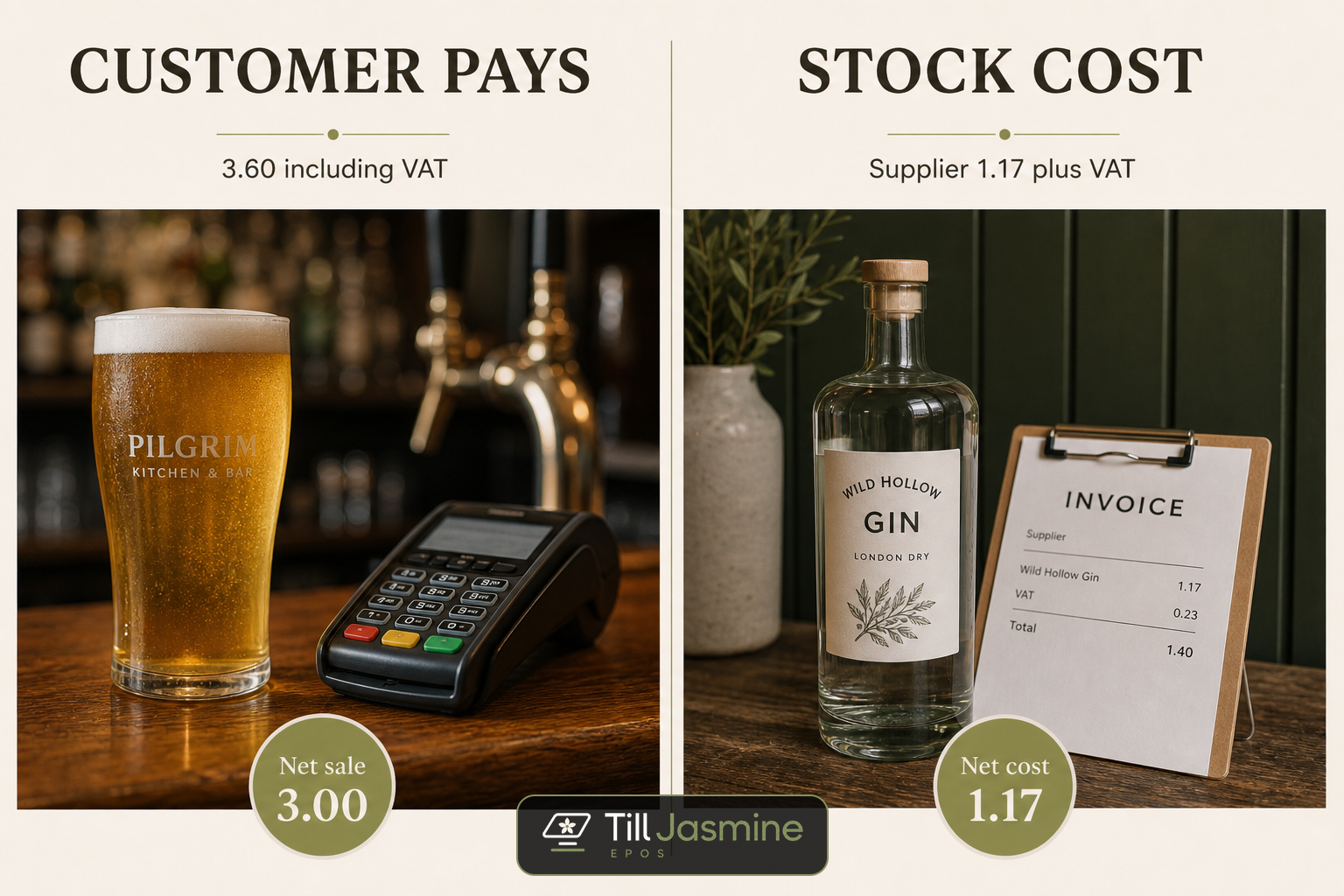
Assume selling price including VAT is £3.60, VAT rate is 20%, net selling price is £3.00, and net product cost is £1.17.
Gross profit = net sales − net cost: £3.00 − £1.17 = £1.83.
Gross profit percentage = gross profit ÷ net sales × 100: £1.83 ÷ £3.00 × 100 = 61%.
You collected £3.60 from the customer, but £3.60 is not all sales revenue available to the business. £0.60 represents output VAT, leaving £3.00 of net sales against which the stock cost can be compared.
Why not just use £3.60 minus £1.17?
Because that would incorrectly treat VAT collected from the customer as income. Doing that would produce £3.60 − £1.17 = £2.43, then £2.43 ÷ £3.60 = 67.5%.
That may look like your margin, but for a VAT-registered business it would not be a proper like-for-like gross-profit calculation. The business does not get to keep the entire £3.60 as net revenue.
The correct comparison is normally net revenue versus net cost: £3.00 net revenue − £1.17 net cost = £1.83 gross profit, giving 61%.
What happens when you buy alcohol?
Alcohol is particularly useful for explaining this because UK alcoholic drinks are subject to the standard rate of VAT. HMRC confirms that standard-rate VAT at 20% applies to alcohol, in addition to the separate Alcohol Duty regime.
Saying that "alcohol has VAT" does not mean that you should automatically add 20% VAT to the cost entered into your EPOS. You first need to determine what the supplier's quoted cost actually represents.
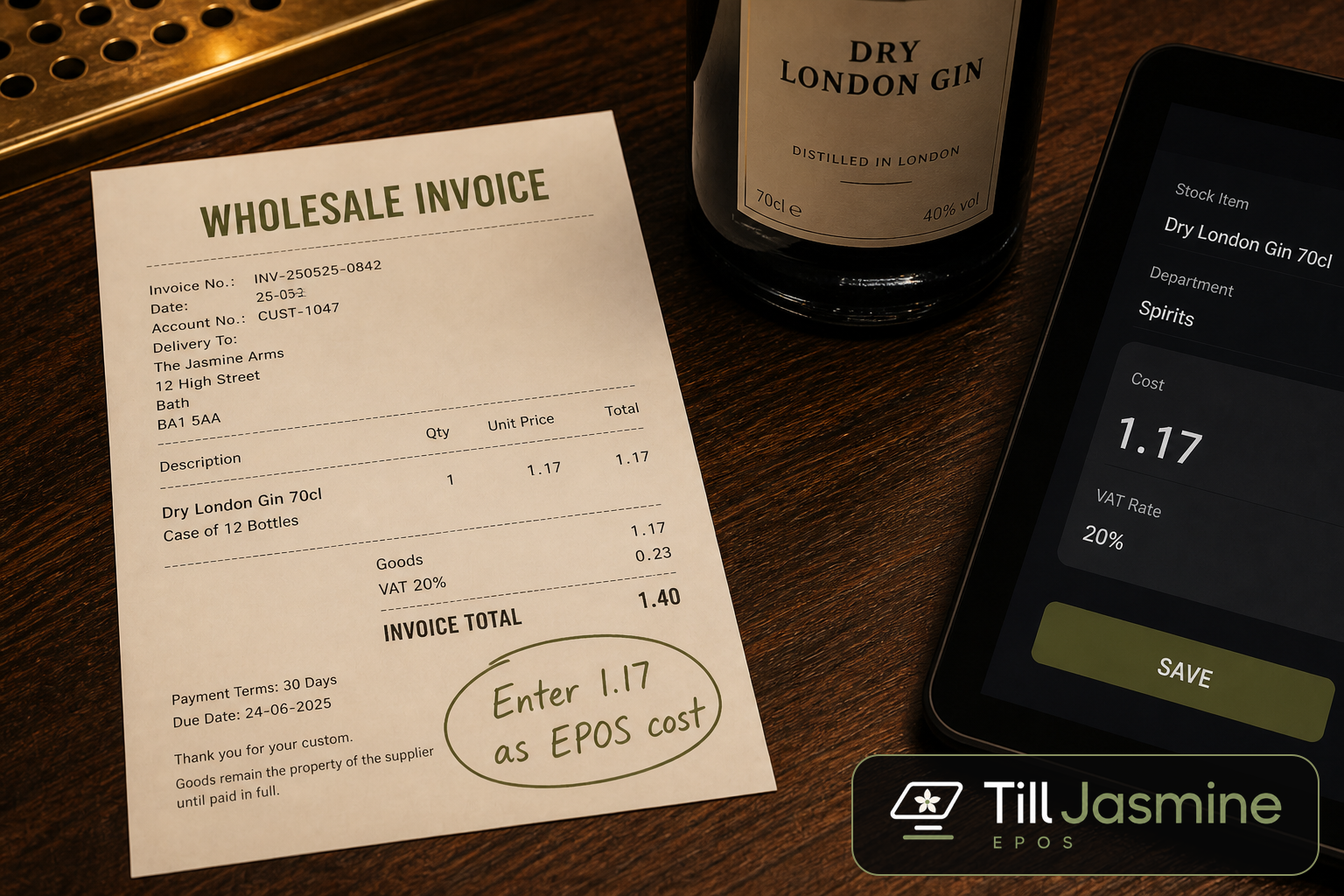
Example 1: supplier charges £1.17 plus VAT
Imagine your drinks wholesaler invoices you: product cost £1.17, VAT at 20% £0.234, invoice total £1.404. You physically pay approximately £1.40.
If your business is VAT registered and that input VAT is fully recoverable, your net stock cost remains £1.17. That is what belongs in Cost price — not £1.404. The VAT portion is dealt with through your VAT records rather than being treated as product cost.
Example 2: supplier says £1.17 including VAT
This is different. Suppose the supplier tells you that £1.17 is the VAT-inclusive price. Remove the VAT:
- £1.17 ÷ 1.20 = £0.975
- Net cost = £0.975
- VAT = £0.195
- Total paid = £1.17
If that £0.195 VAT is reclaimable, the cost you would normally use for margin purposes is approximately £0.98, not £1.17.
The difference can change your gross profit significantly
Using our £3.60 selling price, net selling revenue is £3.00. Suppose £1.17 was actually a VAT-inclusive supplier price. Its net cost would be £1.17 ÷ 1.20 = £0.975.
Gross profit would therefore be £3.00 − £0.975 = £2.025, and the margin 67.5%.
But if you incorrectly entered £1.17 as the net cost, the EPOS would calculate £3.00 − £1.17 = £1.83, a 61% margin. The product would appear less profitable than it really is.
What if my alcohol supplier doesn't show VAT?
Alcohol being a VATable product does not automatically mean every person selling alcohol will show VAT separately on every price or document. The first question should be: is the supplier VAT registered, and is this a proper VAT invoice?
Only a VAT-registered person can issue a VAT invoice. HMRC also requires appropriate documentary evidence when a business claims input VAT.
If your supplier is not VAT registered, they do not simply add 20% VAT to their selling price for you to reclaim. If you genuinely purchase something from a non-VAT-registered supplier for £1.17 and no VAT has been charged, then purchase price is £1.17, recoverable VAT is £0, and effective product cost is £1.17.
You should not artificially calculate £1.17 + 20% and enter £1.404 into your EPOS. The business only incurred £1.17 of stock cost.
But I still have to charge VAT when I sell it, don't I?
If your business is VAT registered and the sale is standard-rated, yes. Your supplier's VAT status — and whether that purchase was food, drink, or something else — does not automatically determine the VAT treatment of your sale.
This is everyday hospitality. You can buy zero-rated food for £1.20 with no VAT on the invoice, then sell it eaten in for £4.80 including 20% VAT. Cost stays £1.20. Net sale is £4.00. Output VAT is £0.80. The same sandwich taken away cold may be 0% on the till — still with a £1.20 cost.
The same idea applies to drink. Imagine you buy a bottle for £1.17 from a supplier who has not charged you VAT. Your effective cost is £1.17. You then sell the bottle for £3.60 including 20% VAT. Your sale still breaks down as net sale £3.00 and output VAT £0.60. Gross profit is £3.00 − £1.17 = £1.83, a 61% margin.
There was no input VAT on the purchase to recover, but there is still output VAT to account for on your taxable sale. That is perfectly possible. The cost is not supposed to "include the VAT you will charge later".
Why don't most tills have "VAT cost" and "non-VAT cost" buttons?
Many EPOS systems are designed around a simple accounting principle: store the effective net product cost, then apply the appropriate VAT treatment to the sale separately.
The till primarily needs the product cost to calculate stock valuation and gross profit. The purchasing and accounting system is normally responsible for tracking supplier invoice total, input VAT, net purchases, VAT liability, credit notes, and supplier balances.
So rather than storing cost £1.17, purchase VAT £0.23, and gross supplier cost £1.40, Till Jasmine simply asks for Cost price: £1.17.
"VATable product" does not mean "add VAT to the EPOS cost"
A product being VATable tells you how VAT applies to the supply. It does not automatically tell you which number belongs in Cost price.
Ask: what is my actual cost after recoverable VAT has been removed? For a VAT-registered business that can fully recover VAT on the stock purchase, that will normally be the supplier's net price excluding VAT.
What about Alcohol Duty?
Alcohol Duty is a completely separate tax from VAT. HMRC states that Alcohol Duty applies to alcoholic products and is based primarily on the amount of pure alcohol and the applicable duty rate.
The important distinction for EPOS costing is this: recoverable VAT is normally removed from your cost calculation. Alcohol Duty generally isn't.
If you buy a bottle from a wholesaler, the wholesaler's selling price may already reflect duty incurred further through the supply chain. You do not simply look at the bottle, calculate the Alcohol Duty yourself, and deduct it from your EPOS cost in the same way you might strip recoverable VAT from a VAT-inclusive purchase price.
If the invoice says goods £100, VAT £20, total £120, the £100 net goods figure may already economically reflect manufacturing costs, import costs, Alcohol Duty, transport, and wholesaler margin. Your EPOS normally cares that your net purchase cost is £100. The recoverable £20 VAT is separate.
A practical bar or restaurant example
Suppose a bar purchases a case of 12 bottles. Supplier invoice: net case cost £14.04, VAT £2.808, invoice total £16.848.
Net cost per bottle: £14.04 ÷ 12 = £1.17. The business therefore enters Cost price £1.17.
The bottle sells for £3.60 including VAT. At 20% VAT, £3.60 ÷ 1.20 = £3.00 net revenue. Gross profit per bottle is £3.00 − £1.17 = £1.83. Gross margin is 61%.
Cash collected from the customer is £3.60, but the £0.60 output VAT is not included in the net revenue used for the margin calculation. Likewise, although the business originally paid VAT to the supplier, recoverable input VAT is not normally included in the £1.17 stock cost. That gives a proper net-versus-net comparison.
What if you are not VAT registered?
This changes the picture significantly. If a business is not VAT registered, it generally cannot recover input VAT in the ordinary way.
Suppose your supplier charges net stock price £1.17, VAT £0.234, total paid £1.404. For a business unable to recover that VAT, approximately £1.40 is genuinely part of what that stock has cost the business. Entering only £1.17 as your true economic cost could overstate your gross profit.
EPOS configuration should match the accounting position of the business using it, rather than applying one rule blindly to every company.
What if some VAT cannot be reclaimed?
There are circumstances where VAT recovery can be restricted or unavailable. Therefore, "always enter the cost excluding VAT" should not be treated as an absolute rule for every business in every situation.
The better rule is: use the cost to the business after accounting for any VAT that is actually recoverable. Where input VAT cannot be recovered, some or all of that tax can effectively form part of the business's cost.
Businesses with unusual VAT arrangements, partial exemption, mixed business and private use, or other special circumstances should confirm their treatment with their accountant or VAT adviser.
Why gross profit should usually be calculated excluding VAT
Gross profit is intended to tell you how much money the actual trade generates after the direct cost of the product. VAT collected on behalf of HMRC does not ordinarily represent trading revenue. Likewise, recoverable VAT paid to suppliers does not ordinarily represent a permanent trading expense.
Comparing VAT-inclusive revenue against VAT-exclusive cost — or VAT-exclusive revenue against VAT-inclusive recoverable cost — creates distorted margin percentages.
For ordinary VAT-registered trading activity, the cleaner comparison is: net selling price − net product cost = gross profit. Then: gross profit ÷ net selling price × 100 = gross profit percentage.
Worked example: £3.60 selling price and £1.17 cost
| Calculation | Amount |
|---|---|
| Customer selling price | £3.60 |
| VAT rate | 20% |
| Net selling price | £3.00 |
| Output VAT | £0.60 |
| Net product cost | £1.17 |
| Gross profit | £1.83 |
| Gross profit margin | 61% |
The EPOS has not calculated VAT from the £1.17 cost. The VAT on the sale is calculated from the selling price. The £1.17 cost is then deducted from the £3.00 net revenue to determine gross profit. That distinction is the heart of the calculation.
Same idea when the purchase had no VAT — eat-in food
| Calculation | Amount |
|---|---|
| Supplier food cost (no VAT charged) | £1.20 |
| EPOS cost price | £1.20 |
| Eat-in selling price | £4.80 |
| Till VAT rate | 20% |
| Net selling price | £4.00 |
| Output VAT | £0.80 |
| Input VAT to reclaim | £0.00 |
| Gross profit | £2.80 |
| Gross profit margin | 70% |
The till charged 20% because the sandwich was eaten in. The cost stayed £1.20 because the supplier never charged VAT. Forcing both sides onto 20% would make the margin look better than the business actually earned.
Common EPOS mistakes
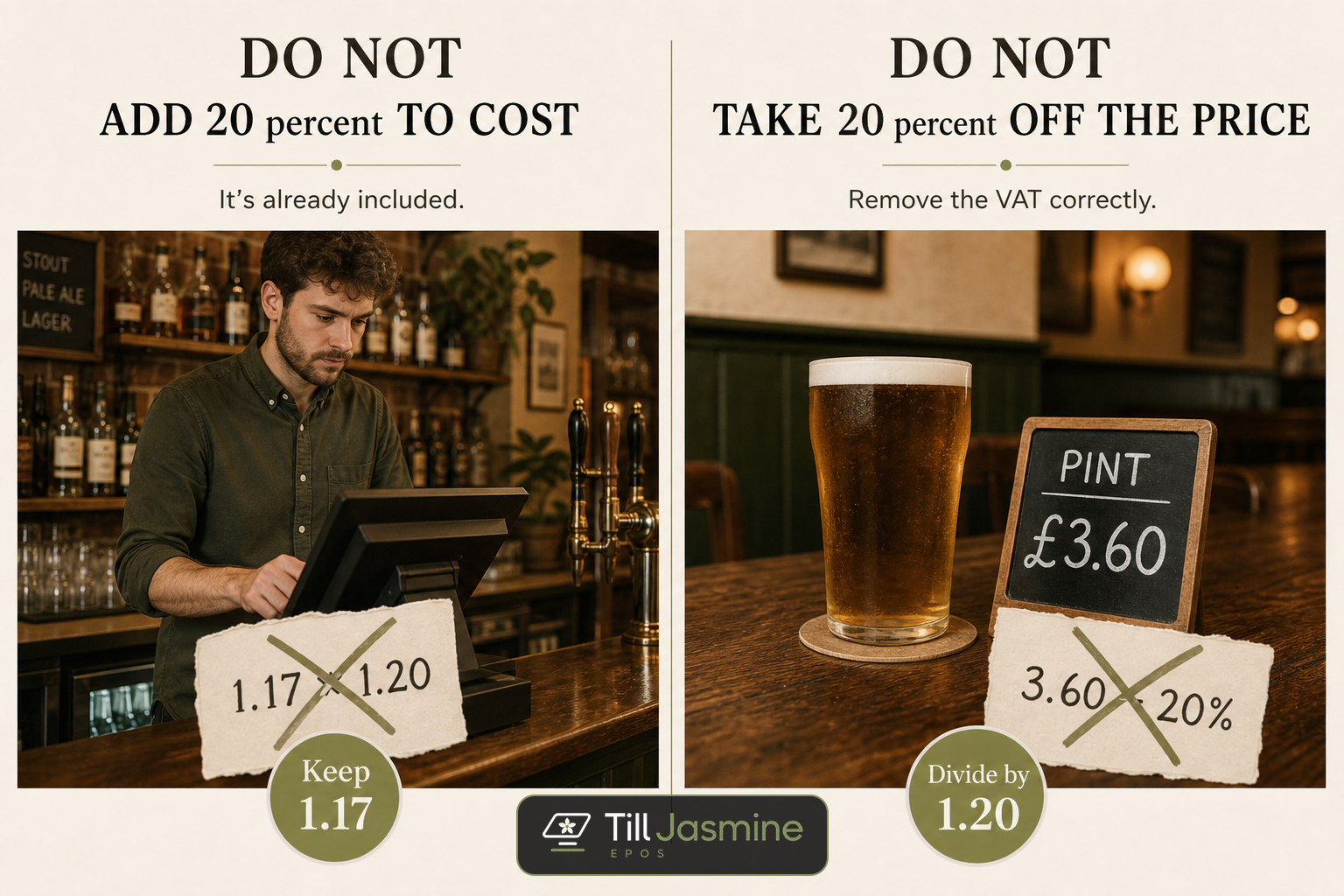
Adding 20% VAT onto the cost manually
Suppose your supplier invoice says £1.17 + VAT. Some users see "20% VAT" and enter £1.17 × 1.20 = £1.404 as the EPOS cost. If the VAT is recoverable, this is likely to make the EPOS margin artificially low.
Correct net cost £1.17 gives GP of £1.83 and 61%. Entering £1.404 would produce £3.00 − £1.404 = £1.596, or about 53.2%. That could lead to poor pricing decisions.
Removing 20% from a VAT-inclusive price
Suppose your selling price is £3.60 including VAT. Some people calculate £3.60 − 20% = £2.88. That is incorrect, because £3.60 represents 120% of the net price, rather than the net amount being 80% of £3.60.
The correct calculation is £3.60 ÷ 1.20 = £3.00. The same applies to a VAT-inclusive supplier cost. If an invoice price of £1.20 includes 20% VAT, the net price is £1.20 ÷ 1.20 = £1.00, not £1.20 − 20% = £0.96.
Stripping 20% off a food cost because the till charges 20%
If the supplier did not charge VAT, dividing the food cost by 1.20 is the opposite mistake. The sale rate does not change what the stock cost. Eat-in VAT belongs on the selling price only.
Why accurate cost prices matter so much in hospitality
A few pence entered incorrectly might not look important at individual-product level. Across thousands of sales, however, inaccurate cost prices can seriously distort management information.
Bars, restaurants, pubs, hotels, and hospitality businesses frequently make decisions based on EPOS reports showing product margins, category margins, and theoretical gross profit. If your costs contain recoverable VAT when your sales figures have already had VAT removed, your reported margins can be systematically understated.
That can affect pricing decisions, menu engineering, supplier negotiations, promotions, stock analysis, and financial forecasting. Correct EPOS configuration is therefore not merely an accounting detail. It directly affects the quality of the commercial information used to run the business.
Frequently asked questions
- Does alcohol have VAT in the UK?
- Yes. Alcoholic products are generally subject to the UK standard VAT rate of 20%. Alcohol Duty is a separate tax.
- Should an EPOS cost price include VAT?
- For a VAT-registered business that can fully recover the input VAT on the purchase, an EPOS cost price is commonly entered excluding recoverable VAT. Always check how your particular EPOS defines its cost field.
- If a bottle costs £1.17 plus VAT, what cost should I enter?
- If £1.17 is the supplier's net price and the VAT is fully recoverable, £1.17 is normally the relevant net cost for gross-profit calculations.
- If £1.17 already includes 20% VAT, what is the net cost?
- Divide it by 1.20: £1.17 ÷ 1.20 = £0.975, approximately £0.98.
- Do I add 20% onto an alcohol cost because alcohol is VATable?
- Not automatically. If the supplier price is already stated excluding VAT, and the VAT is recoverable, you normally use that net figure. If the supplier has not charged VAT at all, you should not invent a VAT amount simply because the product is alcohol.
- Is VAT calculated from the product cost?
- Sales VAT is based on the taxable value of the sale, not your purchase cost. Your cost is relevant to profit, but it does not determine how much output VAT is contained in your selling price.
- How much VAT is included in a £3.60 price at 20%?
- £3.60 ÷ 1.20 = £3.00 net, so VAT is £0.60. It is not £0.72, because £3.60 already includes VAT.
- What if my supplier isn't VAT registered?
- A supplier who is not VAT registered cannot issue a VAT invoice charging UK VAT. If you pay £1.17 and no VAT has been charged, there is no input VAT to reclaim. Your £1.17 remains the full purchase cost for margin purposes.
- What is the difference between VAT and Alcohol Duty?
- VAT is a tax on taxable supplies. Alcohol Duty is a separate excise duty applying to alcoholic products. For normal EPOS costing, you should not deduct Alcohol Duty from the supplier's net product price as though it were recoverable VAT.
- Why doesn't food cost include VAT if I charge 20% when I sell it?
- Purchase VAT and sale VAT are separate. Many food ingredients are bought zero-rated, so there is no input VAT to strip from cost. If you then sell that food eat-in at 20%, Till Jasmine still removes VAT from the selling price. The cost stays the amount you actually paid the supplier.
- Can the VAT on a purchase and the VAT on a sale be different?
- Yes. A pint is often bought and sold at 20%. A sandwich can be bought at 0% and sold eat-in at 20%, or taken away cold at 0%. Cost price follows the purchase. The till VAT rate follows how the item is sold.
Final takeaway
The simplest way to understand VAT and EPOS gross profit is: compare like with like.
For a typical VAT-registered business: selling price including VAT → remove the VAT that applies to that sale → net sales revenue. Supplier purchase price → remove any recoverable input VAT that was actually charged → net product cost. Then: net sales − net cost = gross profit.
Those two VAT amounts do not have to match. A pint may be 20% in and 20% out. Eat-in food is often 0% in and 20% out. Cold takeaway food may be 0% on both sides. The cost still adds up, because Till Jasmine never uses the till VAT rate to rewrite the supplier cost.
Drink example: £3.60 customer price → £3.00 net sale → minus £1.17 net cost → £1.83 gross profit → 61% margin.
Food example: £4.80 eat-in price → £4.00 net sale → minus £1.20 zero-rated cost → £2.80 gross profit → 70% margin.
The 20% VAT on a sale is not calculated from the product cost. Do not add 20% to a drink cost just because it is alcohol. Do not take 20% off a food cost just because you will charge VAT when it is eaten in.
What matters is whether the supplier price included VAT, and whether that VAT is actually recoverable. Once Till Jasmine contains the correct net cost, and the correct sale rate, it can give you a far more accurate picture of product profitability.
Official guidance
This article provides general information about UK VAT and EPOS costing and is not accounting or tax advice. VAT treatment can vary according to the business and transaction, so businesses should confirm their individual treatment with an accountant, bookkeeper, or tax adviser where necessary.